
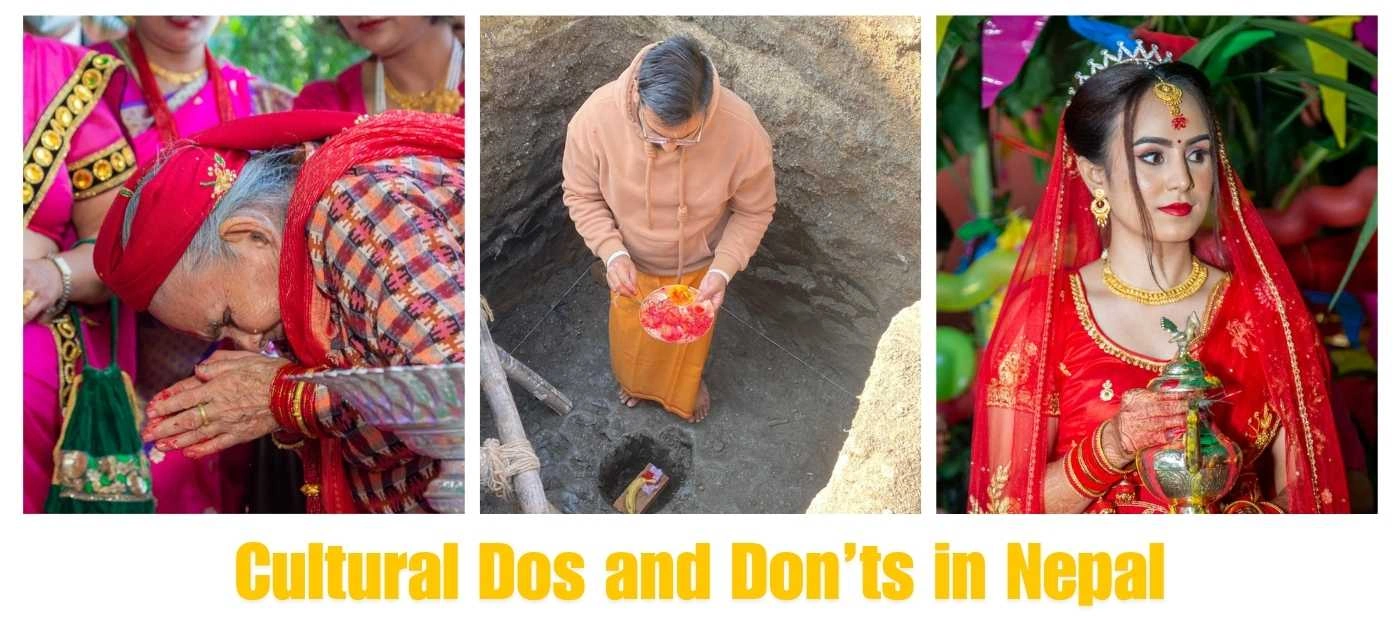
The culture and tourism around the world come together. One can’t separate tourism and culture, as they are interrelated so well. When the culture is rich and people play a great role in tourism. Nepal has more than 100 spoken languages and more than 135 ethnic groups.
Nepal's tourism is made very unique with diverse cultures and traditions due to so many ethnic groups of people living in Nepal. As our country is very diverse geographically, the culture and ethnicity are also very diverse.
Culture of Nepal: Do's and Don'ts for tourists
Nepali culture is very welcoming to tourists. Nepali people are happy to share their food cultures, festival cultures, local customs, and traditions. Nepal practices Hindu culture and Buddhist culture and a small majority of Muslim and Christian cultures.
Nepal is very unlike other countries; we never fight due to religious culture. The Hindus and Buddhists are the main cultures, and some are Islamic and Christian; they all go along very well and share the celebrations and occasions together. Only some very spiritual and private ceremonies in Hinduism and Islamic culture may restrict other religions. Non-Hindus may not be able to go inside some of the main Hindu temples, but celebrations just outside the temple courtyards are welcome to join.
Dressing culture in Nepal?
Traditionally Nepalese women were and still are in the villages where women wear saris that cover the whole body down to the ankle, but men often can walk around topless and in shorts. But no need to cover heads for women like in Islamic countries.
City and town life have changed and are quite westernized indeed, but it's nice to respect the culture, and people wear clothes that cover the full body. The tourist centers like Thamel in the Kathmandu Valley, Pokhara lakeside, and Chitwan Sauraha have much more freedom, and no one cares what you dress up in or how you dress up.
Eating culture while walking on the street in Nepal?
Most Nepali people won’t eat or drink while walking on the street, except for drinking some water when they are thirsty. But tourists are eating and drinking while walking on the street, and local people are accepting this without any hesitations. Nepali people respect the tourists’ freedom, but drinking alcohol from a bottle in your hand is a bit disrespectful.
Socializing the culture of Nepal with foreign tourists?
Socializing the culture of Nepal with foreign tourists is even easier than with local tourists; Nepali people are very flexible, welcoming, and respectful. They easily make contact with foreigners, and they might be very curious sometimes to know more about you.
Please don’t take it negatively when someone that you have newly met will ask, "How are you?" Where are you from? Then how old are you? What kind of job do you do at home?
These are common to ask in Nepal, and in the western world, it is very rare to ask these kinds of questions unless you know the person well. These are local culture and ways of public display of affection.
How to be respectful while visiting Hindus' temples, Buddhist monasteries, and other holy sites in Nepal?
As a foreign tourist from other cultures and religions, I think it’s very important to be a bit more careful when you are at the sacred sites like Hindu temples and Buddhist monasteries around Nepal. Buddhist monasteries usually allow foreign tourists from other religions to join Puja ceremonies inside the monasteries, but it's always nice to ask them if you can go inside the monasteries.
A Hindu temple may be stricter for foreigners to go inside the main section of the temple as it holds bigger cultural significance, while temple courtyards are welcome to visits. It’s way nice to ask them if you can participate in the ceremonies that are happening outside the temple or inside the temple. If there is no sign of entry being forbidden, you can visit inside. Make sure you avoid touching a sacred object without their permission.
How is the photography culture in Nepal?
Tourists can photograph people, festivities, and ceremonies; they are quite welcoming, but if you ask people to get permission to take photographs of people, they might say no sometimes. It's not because they don’t want to be in the picture, but because they think they are not nicely dressed or they think they are not beautiful or handsome enough to be in the picture. In general you can take photographs of people; ceremonies in the temples or Buddhist monasteries are fine unless they have a sign of "photo forbidden."
When it comes to very special occasions (puja) in the holy Hindu temples or special puja at Buddhist monasteries, they can be very private, and they won’t allow non-Hindu or non-Buddhist people to participate. They are fasting, and they take a holy bath before doing their cultural practices with fresh clothing, so they won’t like it if other people touch them or their worshiping materials. They might not even like to speak with foreign tourists, but this is only in very special cases.